Sicily.
It is the biggest island in the Mediterranean, separated
from the Italian peninsula by the strait of Messina.
It has important mountain groups: Peloritani, Nebrodi,
Madonie, Iblei. The plains are scanty, with the exception
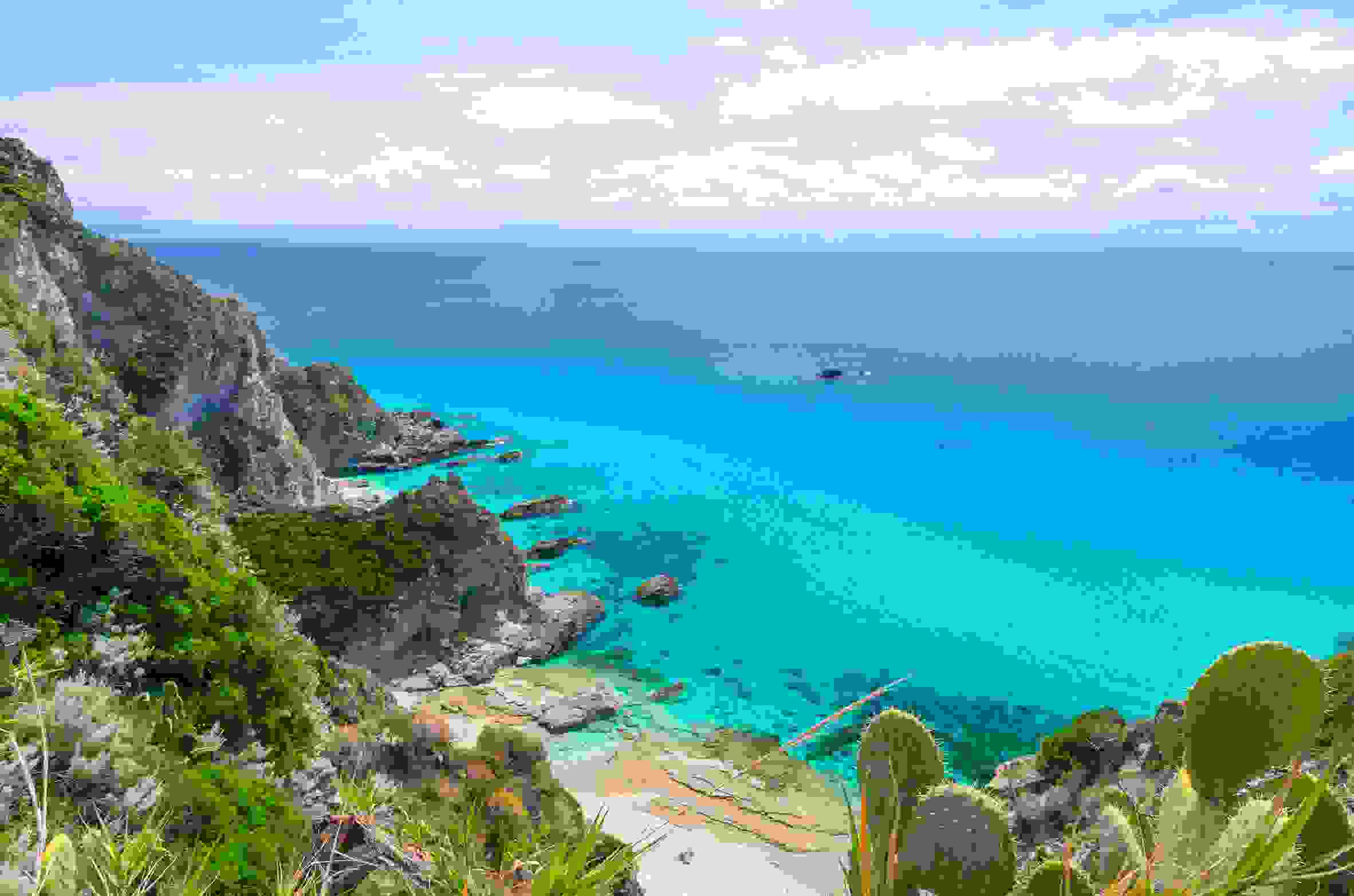
of the area around Catania. The coasts offer a landscape
of fascinating beauty almost everywhere; groups of
marvelous smaller islands are scattered round the
coast (the Eolie or Lipari, Ustica, the Egadi. the
isle of Pantelleria and the Pelagie). The Etna, rising
in the center of a volcanic area of Sicily, is the
highest active volcano in Europe (3,323 meters). The
isles of Stromboli and Vulcano are also active volcanoes.
Cities.
Palermo is the regional capital of Sicily, which is
ruled by a special statue. Other important cities
are Messina, Catania, Agrigento, Syracuse, Trapani,
Ragusa, Enna, Caltanissetta.
Art.
Sicily was a Greek colony during the Classic Age,
the Hellenic heritage is remarkable (Syracuse, Gela,
Agrigento, Selinunte and Eraclea). Important Roman
remnants can be seen at Taormina, Syracuse, Tindari,
Solunto, Eloro and Patti. The next artistic development
took place during the Norman period, which left churches
and palaces of Arab-Byzantine influence. The Gothic
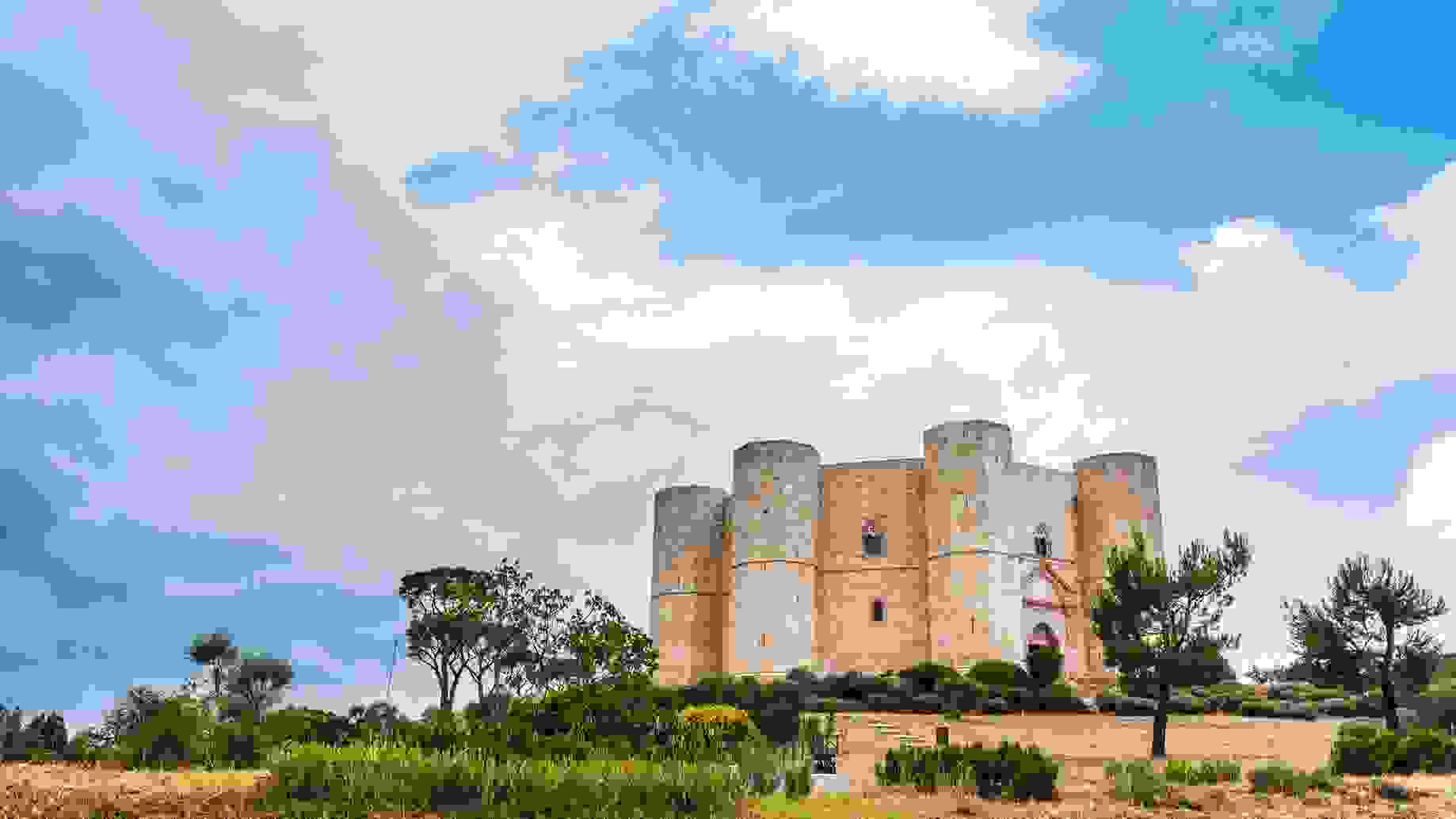
style can be seen in the imperial castles of Catania
and Syracuse; the Catalonian influences produced elaborated
architectural forms during the fifteenth century.
The Baroque style, of exceptional wealth, thrived
in Palermo, Catania, Ragusa, Noto and Comiso.
Museums.
In Palermo the Archaeologic Museum, which displays
a noteworthy Etruscan collection, sculptures and metopes
of the temples of Selinunte; the Regional Gallery
of Sicily, with the most important artistic collection
of the island. The Civic Museum of Catania houses
archaeology, ancient and modern art, relics of local
history. In Syracuse, tourists can visit the Regional
Museum and the Regional Gallery, with very rich archaeologic
and pictorial collections. In Agrigento, there is
the Regional Archaeologic Museum.
To
be visited.
Taormina, the Etna and the majestic monuments in the
Valle dei Templi of Agrigento.
This region faces Calabria over the Strait of Messina,
which is the only conterminous region. The volcano Etna
is situated close to Catania. Etna is 3,320 m (10,900 ft)
high, making it the tallest volcano in Europe. It is also
one of the world's most active volcanoes.
The Aeolian islands to the north are administratively a
part of Sicily, as are the Aegadian Islands and Pantelleria
Island to the west, Ustica Island to the north-west, and
the Pelagian Islands to the south-west.
Sicily has been noted for two millennia as a grain-producing
territory: olives and wine are among its other agricultural
products. The mines of the Enna and Caltanissetta district
became a leading sulphur-producing area in the 19th century,
but have declined since the 1950s.
Bare, arid, sun-baked, all adjectives used by those who
do not know Sicily well.
But there is another Sicily to discover.
The Nebrodi and Madonie mountain ranges are the last offshoots
of the Italian continental Apennines; all around there is
a ferment of hills that end where the sea begins. Your eyes
see only the yellow of the crops and the green of the vineyards.
Bread and wine that this land offers to those who know how
to learn it. If you should wish to explore this land, the
parks, the reserves, the wildlife sanctuaries, you will
discover lots of other colours. And fragrances too.
"Since the time of Proserpina, Sicily has been the
house of flowers. It is said that the virgin Goddesses,
Proserpina, Minerva and Diana, wove a multi-coloured tunic
made of flowers for their father Jupiter... Now I understand
why the Gods loved Sicily so much." This is what was
written in 1880 by a "Milady in Sicilia", whose
real name was Frances Elliot.
Farms, bagli, noblemen's country residences and Baroque
or Liberty-style villas are hidden among "enclosures"
of ancient olive groves, middle-eastern gardens of citrus
fruits, above green hills filled with vineyards or red hills
filled with "sulla" - a strange pulse used as
fodder - which dominate these landscapes that take your
breath away. Ancient lands full of great emotions. And excitement
if you are interested in matters of the soul. This is Sicily.
Many of these buildings are now rural tourism centres that
offer an ancient asset: hospitality. A value that the Sicilian
people continue to honour. Together with the flavours of
a cuisine that is deep rooted in the rural-farming world
of the Siceliots, the Greeks of Sicily. With a glass of
wine on the table, they will tell you a thousand stories
about those who created them. These are perhaps the same
stories told to everyone that has preceded you in the last
three thousand years.
Hospitality, relaxation, good food and a discreet invitation
to come and learn about the territory. There are lots of
things to do: from skiing down the slopes of Etna, swimming
if you are on the coast, canoeing or sailing, if you want
to feel the thrill of the wind. Or diving into the sea's,
depths that hide the remains of ancient sunken ships. And
the pleasure of little discoveries.
On foot, on horseback, on bicycle, to follow the traces
of their civilisation step by step. A civilisation that
on this island is truly ancient.
The Sicilians have always been used to strangers. However,
they can make you feel as if you are the first to arrive,
privileged to enjoy their food and their friendship. You
will feel like gods all of a sudden. And you will not feel
time slipping by. Because "where the Gods lived walking
around as men, there can be no dull days like in other parts
of the world". That is what Frances Elliot wrote.
The
sea and the islands.
Tears of lava, limestone plains swept by the wind, sunny
lands the colour of bronze: one by one the islands decorate
the Sicilian coast like a string of pearls on the neck of
a beautiful woman. There are fourteen of these daughters
of Sicily, not including Motya, which at low tide is sometimes
linked to the coast of Marsala. Fourteen paradises of untouched
beauty. Some have an African charm, such as the Pelagie,
in the province of Agrigento, and Pantelleria in the province
of Trapani. Others, the uncontested mistresses of the sea
and its secrets, Levanzo, Favignana, and Marettimo, form
the archipelago of the Egadi in the sea off Trapani. Further
north, in splendid isolation, is Ustica, the island of Circe,
with its unspoilt marine reserve. And in the Aeolian islands,
in the province of Messina, water meets fire. Here nature
still dictates. Its rhythms, and travellers can let themselves
be enchanted by the magic spell of the fishermen and farmers
who inhabit these isles, the last custodians of the ancient
Mediterranean traditions. The choice is yours - between
the lively throngs on the Aeolian Islands, the peace and
quiet Pelagie, and the perfumes of the Egadi.
The sea is perennially the colour of sapphire, the domain
of dolphins and swordfish. And so it has been since the
dawn of time.
What is the identity of this land born of the waves?
You may find yourself asking this question after your first
encounter. Indeed it may well happen. For it is not easy
to grasp the meaning of this island, which is itself a continent.
But don't despair - that's how it always is: at first sight
you may well not fully understand.
It is not easy to understand Sicily.
Just like a beautiful woman, Sicily needs a certain type
of approach and cannot be easily won. All you can do is
to let yourself be seduced. Just as the first Mycenaeans
were seduced when they came this way to buy obsidian and
pumice-stone in the Aeolian Islands, when nothing else was
known for cutting and polishing. Just like the Phoenicians,
who along these very coasts set up their trading stations
and left them in the charge of people taken on in every
corner of the Mediterranean, people who lived in peace,
trading with Siculs, Sicans, and Elymians.
Why were they called Elymians? Ex limen, in Latin means
refugee, driven from home. This gives an immediate picture
of the ancient island civilization. Everyone was always
welcome. Just like the Greeks, seeking somewhere to live
in peace, and hosts of others. As happens today to many
other unfortunates who escape to these shores, fleeing from
poverty, war, famine, and oppression.
Sicily welcomes everyone. In civil fashion, and
has always done so.
And one and all become Sicilians. For you don't have to
be born here.
Hermocrates of Syracuse made this point way back in 424
BC, when he said: “We are neither Ionians nor Dorians,
we are Sicilians.”. We use the hand gestures of the
ancient Phoenician merchants, we are as crafty as the Greeks,
as captious as the Byzantines, and as blasé as the
knights of Andalusia, and we still show great respect for
the dead and for the necropolises of all those who died
on the island. In our language, behaviour, food, and religion
we carry fragments of Greek culture, but also Roman, Byzantine,
Muslim, Norman, Angevin, Aragonese, Catalan… Each
of these has left a mark, architectural traces, masterpieces
of art, transforming the island into a unique open-air museum.
Sicily offers pleasure and joy to each and every
one of its visitors.
And to think that in the Middle Ages Sicily was described
as being “seared and riven by lava and sun, like a
hell on earth, inhabited by people more devil-like than
human”. At the other extreme is the “invention”
of the Sicily described by Stendhal, whose “Duchesse
de Palliano” declares: “…as I travelled
through Sicily, my purpose was not just to observe the natural
phenomena of Etna or to clarify to my own mind and to that
of others what the ancient Greek authors said of Sicily.
Above all I sought the pleasure of the eye, which in this
singular land is truly great. ”.
“Of all the imaginable forms of dissolution, travelling
is the greatest I know; it is what one invents when one
is tired of other people... One may sometimes get angry,
but at least one amuses oneself, and immensely so.”
Thus spoke Gustave Flaubert. And, reading between the lines,
this reveals the supreme and sublime voluptuousness of a
journey of discovery.
Sicilian architectural remains are amongst the finest of
all antiquity. It is not easy to resist the charm of works
whose beauty has conquered visitors of every epoch. Particularly
the cultured travellers completing their “Grand Tour”.
The greatest of these, the “Traveller” par excellence,
is beyond any doubt Wolfgang Goethe. Even if his “Italienische
Reise” has been criticized by many for its omissions,
inaccuracies, and trivialities. How can that be? It is simply
that his is a journey to the end of history, the end of
time; that great journey that each of us would like to make
into the heart of human nature. Perhaps we can find Aleph
in this island, the place where all places meet, the history
that contains all histories. The city of the dead at Pantalica,
which becomes a charming place to live in.
And there lies the clue to it all - Goethe did
not write a “baedeker”. And neither do these
few pages claim to be one. We are just at the invitation
stage.
We would like you to come to Sicily, to see, to learn, to
enjoy, to savour what has enchanted all those who have come
here in the past four thousand years. And to dream. Roving
this way and that, with a good guidebook in your hand, in
the archaeological parks of Piazza Armerina or Selinunte;
witnessing the ancient spectacle of sunset in the Greek
theatre at Taormina or from the ruins of Megara Hyblaea.
And to swim in the sea at Camarina, knowing that under the
sand are the relics of ancient ships. And to sail along
the coasts like Ulysses, witnessing dawns and sunsets, while
the coast stretches out before you with its monstrous architectural
horrors, which can be pardoned only by the sudden appearance
of a temple or twin columns still standing on a coast that
is sometimes unspoilt.
Itineraries
of faith.
Are Sicilians religious? They must certainly be cautious,
if you consider there are almost seven hundred patron saints
looking after the 389 Sicilian towns! Palermo alone has
twenty "ordinary saints", fifteen "principal
saints", four female "patron saints" who
can be seen at the Quattro Canti, and one "patron to
watch over all", Santa Rosalia. Why so many saints?
Perhaps because, unlike God, they too were once mortals
on this earth and were considered to be the only ones capable
of understanding and providing for human needs. And then,
after all, it's the saints who perform miracles…The
festivities in their honour originate from ancient pagan
cults, rites linked to the solstice and the seasons, while
others may strictly speaking have little to do with religion.
From the tenth to the fifteenth of July, in the sweltering
heat of summer, the inhabitants of Palermo are in a state
of frenzy: it's Festino time.
The Festino is hard to explain.
It is most certainly the peak moment of city life, a gigantic
popular ex-voto dedicated to Santa Rosalia as a thanksgiving.
She it was who saved the people of Palermo from the plague
in 1624. This is the last surviving example of the "baroque
festivals" of Europe, with a triumphal chariot, huge
enough to transport a band of musicians. It is a symbol
of the city, unique in Europe, demonstrating the wealth
and splendour of Palermo. An act of municipal pride, to
remind people - spectators and participants alike - of the
City's regal dignity! Still today, for many, Santa Rosalia
remains the Great Hope.
Our cuisine is a perfect blend of all the influences of
the various cultures that have followed each other in the
island.
Rather than a cultural residue, it is the most resistant
trait of a whole culture. The dining-table is the place
of introspection of all the different civilizations that
have passed through the island. An ancient pleasure indeed,
if it is true that Plato, once visiting Syracuse, criticized
its citizens for "sitting down at table several times
a day".
Sicilian cuisine? There are three sorts: the patrician
or baronial cuisine, that of the ordinary people with all
its lively inventiveness, and street cuisine, i.e. that
of the "buffittieri", as they used to be called,
a term originally derived from the French buffet.
An immense wealth and variety of dishes, since every city,
town, and family has always had its own version of each
recipe, reflecting the island's strong sense of individuality.
While the Monsù, the chef to the great aristocratic
families, produced in the palaces celebrated dishes of soles
and groupers, hares and capons, the people down below could
enjoy the aromas and the fantastic descriptions made by
the servants. With great imagination and skill these dishes
were reinvented using ingredients that were often quite
basic. De-boned sardines were promoted to the rank of soles:
"lenguado", in the Spanish of the nobles, meant
"sole", and thus sardines a linguata were created.
A certain small bird similar to the blackcap, when skilfully
prepared, became the beccafico that the Monsù proudly
served in jelly with pickles. Aubergines were thus disguised
as "quails" and even as "parmiciana",
which is a dialect word meaning simply a shutter. Nothing
to do with Parma and its parmesan cheese. And from the aubergine
also came the queen of popular cuisine, caponata, the aubergine
appetizer served as a sweet and sour sauce and originally
created in the kitchens of the courts of pre-Islamic Persia.