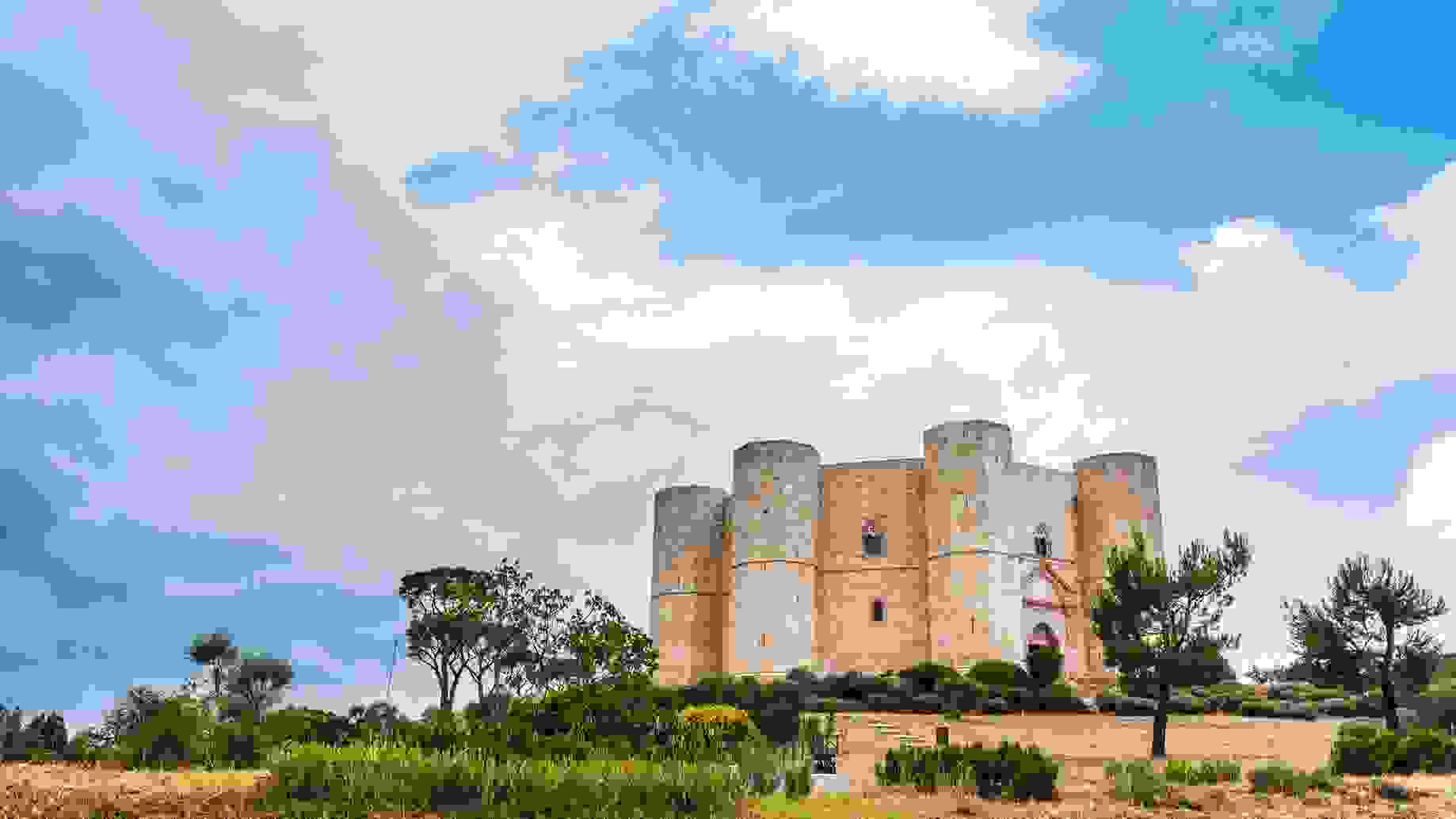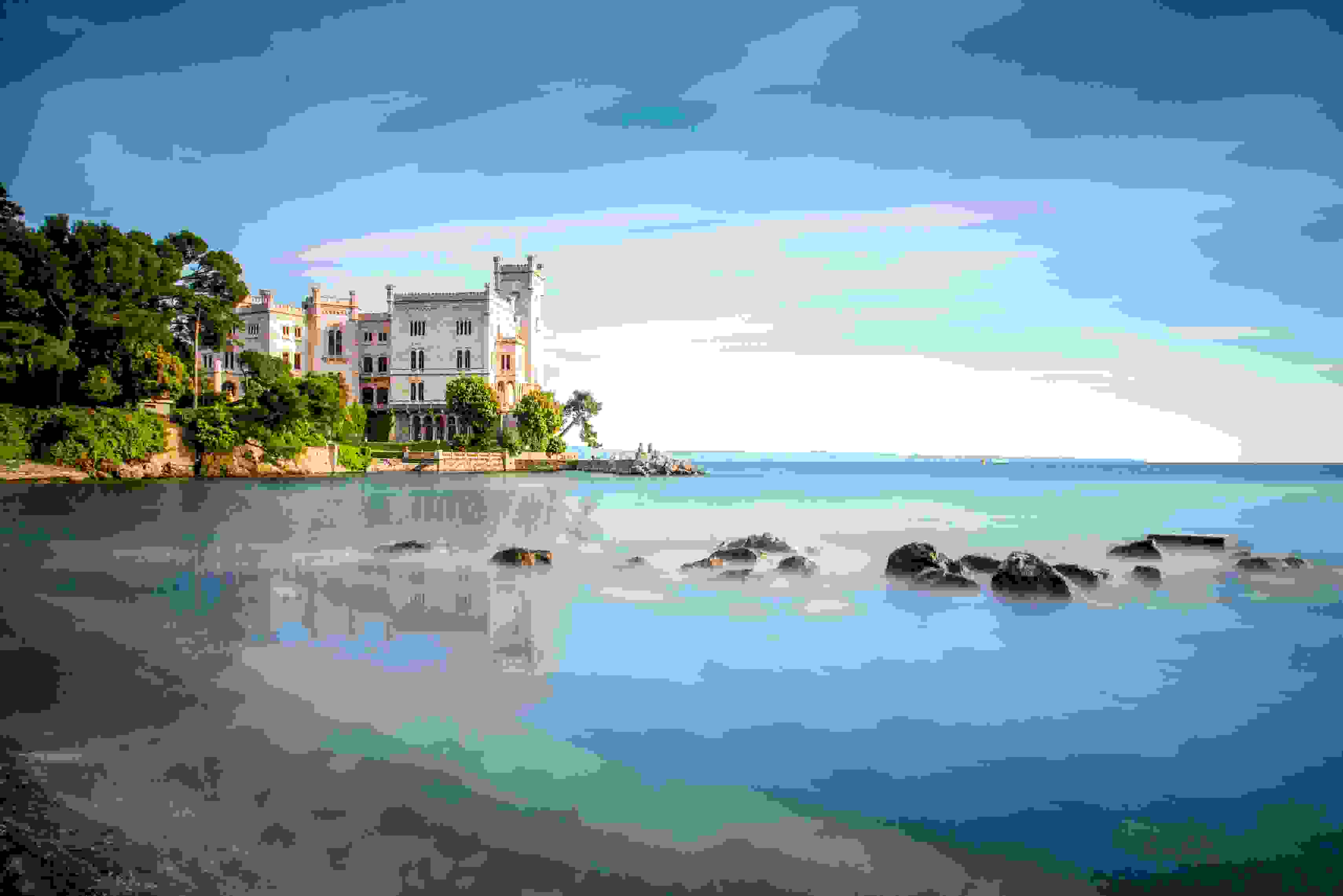
Basilicata.
The region is mountainous, arid, scarcely watered.
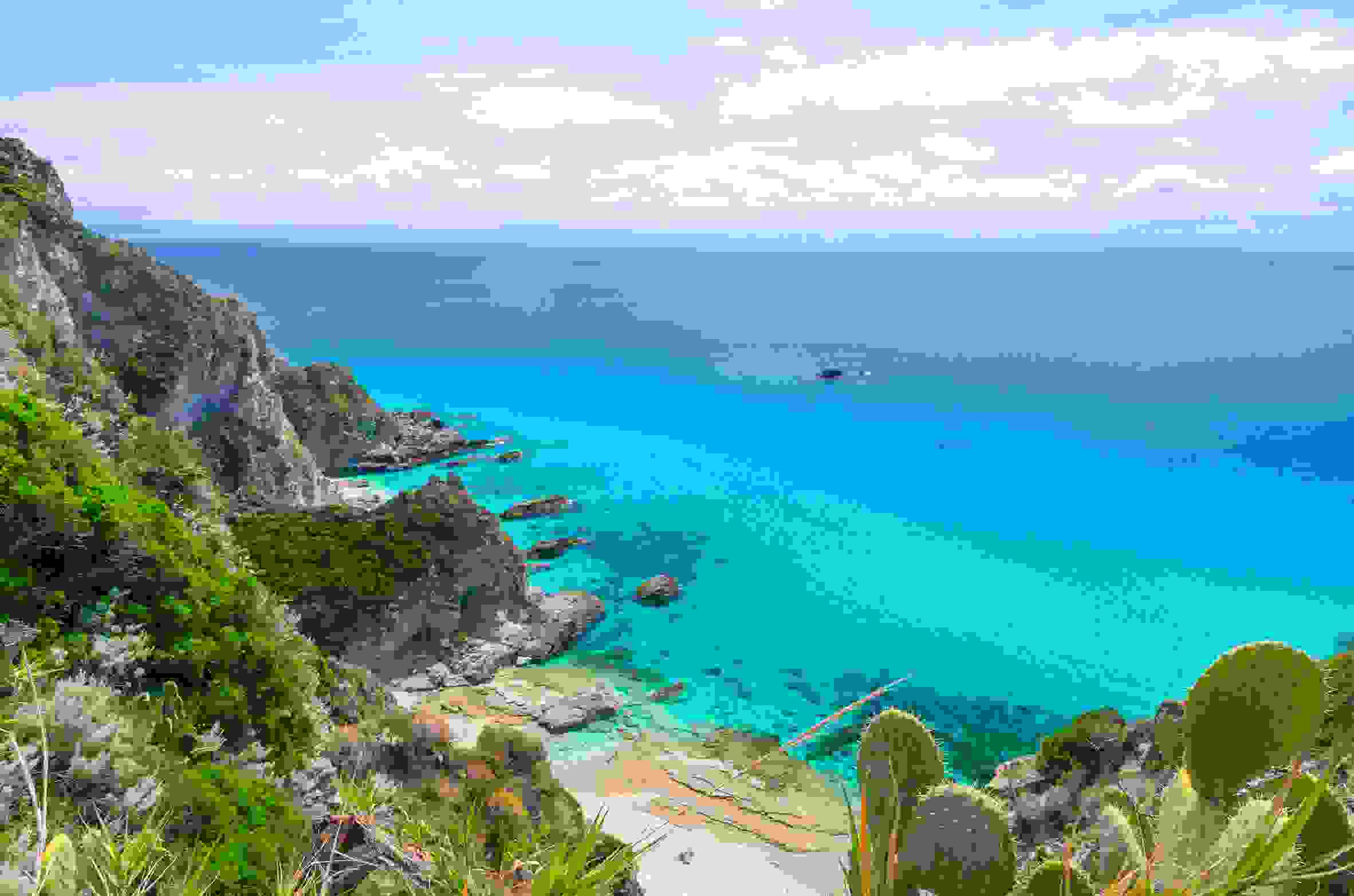
It has two coastlines, one in the center of the Gulf
of Taranto in the Ionian Sea, and a tiny one on the
Tyrrhenian Sea, with the famous sea resort of Maratea.
The bare mountain landscapes slope down to the Ionian
Sea.
Cities.
Potenza is the regional capital; Matera is the capital
of the other province.
Art.
The region is rich in archaeologic relics, dating
back to the most remote times. Remains of the Greek
era can be found in Metaponto (the Palatine Tables),
while ruins of the Roman Age can be seen in Venosa.
Tourists can admire noteworthy examples of medieval
art in Venosa and Cerenza (Romanesque style). The
architecture presents Arab-Byzantine and French influences
in Matera, Melfi and Lagopesole. In this region, the
Baroque style shows an evident Neapolitan influence.
Museums.
The Provincial Archaeologic Museum of Potenza houses
an important prehistoric collection, an interesting
ethnographic section and numerous Greek and Latin
inscriptions. In Matera, the Ridola National Museum
holds Paleolithic relics, and ceramics which date
back to the Neolithic, Bronze and Iron Ages. The Pinacoteca
d’Errico displays noteworthy paintings of the
Neapolitan school of the seventeenth and eighteenth
century. The Archaeologic National Museum of Melfi
houses prehistoric, protohistoric and Roman relics.
To
be visited.
In Matera, visitors can see the “Sassi”,
the typical houses and churches dug into the “tufa”
crag. In the Gulf of Policastro, tourists can enjoy
the fascinating Maratea, an important resort of the
Tyrrhenian Sea; on the Ionian Sea, the Antiquarium
of Metaponto.
The
Territory.
The surface area is 9,992 square kilometres; the 617,000
inhabitants are shared throughout the 131 comuni (town
councils) in the provinces of Matera and Potenza:
7/10ths of the territory comprises mountainous areas,
2/10ths are hills, while 1/10 is plain. The mountains
are found to the west while the coastal and central
area is hilly and in the Melfese area the ground is
higher and woodier reaching towards the arid Murgia
in the Matera district. The region has only acquired
its current name in recent times. In the Classic era
it was known as Lucania, and this was brought back
during Fascism which lasted until the 27th December
1947 when the new Constitution of Italy officially
sanctioned the name Basilicata.
By
car.
From the Tyrrhenian coast: traveling along the A3 Salerno-Reggio
Calabria highway, exit at Sicignano and take the Basentana
(SS 407) state road link to Potenza, which will be reached
after about 48 kilometers.
To get to Matera, continue on the Basentana road for other
74 kilometers, then take the state road for Matera (SS 7);
the town will be reached after about 30 kilometers.
The Basentana state raod continues until Metaponto and ends
on the SS Jonica 106 Taranto-Sibari.
From the Adriatic coast: traveling along the A14 Bologna-Taranto
highway (Autostrada adriatica), at Foggia take the route
for Candela (where there is also the conncetion with the
A16 Naples-Bari highway) and continue for Melfi and Potenza.
From the A14 Bologna-Taranto highway you can reach also
Matera taking the exit for 'Bari Nord' and then travelling
along the SS 96 in direction Altamura (for about 60 kilometers).
By
railway.
From the Tyrrhenian coast: a route that goes across Basilicata,
connecting Potenza with Taranto, leaves from the 'Ferrovie
dello Stato' railway station of Battipaglia (Napoli-Reggio
Calabria line).
From the Adriatic coast: it is possible to reach Potenza
through the Foggia-Potenza line; Matera can be reached with
'Ferrovie Appulo Lucane (FAL)' railways. The Jonian coast
is crossed by the 'Ferrovie dello Stato' line Taranto-Sibari.
By
airplane.
From the Tyrrhenian coast: Potenza-Napoli Capodichino -
about 159 Km.
From the Adriatic coast: Matera-Bari Palese - about 64
Km.
Maratea
- Night life in Maratea.
Maratea supplies its tourists with a wide choice of things
to do in the evening.
While having an aperitif near the harbour and eating an
ice cream or a traditional cake in the central square, a
tourist can have a walk along the old main street or watch
one of the many concerts or theatre performances that Maratea
offers.
Those who like shopping can go window shopping for handicraft
products and traditional food.
An evening can end in a disco along the Maratea Coast;
among which there are Santo Janni and the disco of the Pianeta
Maratea.
Pignola
- Sellata Ski Station.
About 20 km far from Potenza, in the Abriola area, it is
located in the tourist resort of Sellata-Pierfaone.
Its wonderful position with an extraordinary view and its
equipment make it one of the most skiing resorts in the
region.
Sellata can be reached from Potenza through a direct road
that, passing through Pignola, goes up to the height of
1,255 metres.
In this area there are two chair lifts called ‘Pierfaone’
(1,500 metres long) that serve rather challenging slopes.
Higher up there is a cross-country skiing area.
The ski station is plunged in the wonderful green frame
of the Basilicata woods, that reach the top of the Volturino
Mountain and Fossa Cupa and Arioso springs, towards Pietra
del Tasso and the famous Sanctuary of the Madonna dei Saraceni.
Pignola
- The Air Base of Pantano Lake.
The Air Base of Pantano Lake is amongst the most beautiful
ones in Italy. It started working in 1991.
Beside the landing strip, this place has an important sports
centre with five-a-side football and tennis fields, skating
rinks, two covered swimming pools and a good restaurant.
Inside this centre, families and visitors can practice
several activities, such as attend a flying school for flying
ultra light planes, let their children play in the well-equipped
playgrounds and taste the specialties of the restaurant.
The Air Base is 600 metres long and is in the plain of Pignola.
Its beauty is increased by the presence of a winch for
sailplanes: a facility that few Italian air bases have.
Senise
- Sport on the Senise Lake.
On the shores of the Senise Lake a beautiful sports centre
was created a few years ago. It has increased the value
of the social and economic activities of this area.
This centre is so well equipped that it can offer football
fields, five-a-side football fields, basket, tennis and
volleyball fields.
Beside these traditional sports there are some more exclusive
ones, such as rowing, canoe and sailing through very beautiful
water courses created on the shores of this artificial lake.
Because of this peculiarity the ‘Federazione Nazionale
dei Canottieri Lucani’ has chosen the Senise Lake
as site for some important national rowing events, hosting
athletes from the whole of Italy.
Trecchina
- Karting.
At the foot of Trecchina, in a wide valley, there is a modern
and well-equipped karting track.
The track is 656 metres long and can be used for 160 cc.
and 270 cc. karts.
This structure offers other facilities, such as a cafe’
and a restaurant that is now being enlarged.
Here tourists can have a sporting day in Trecchina wood.
Regattas are even more evocative because of the beautiful
landscape of the ‘Parco Nazionale del Pollino’
and match together sport and nature in a wonderful pair
of health and environment.
Bernalda-Metaponto
- Golf Centre.
Into an agricultural farm of 80 ectars, this golf centre
has not changed the original aspect of the places: 18 points
enveloping in fruits , wine trees and mediterranean vegetation.
How to get:
Autostrada A14 Bologna-Taranto (Highway), go right to the
Statale 106 Jonica (Jonian State Highway), direction Reggio
Calabria go right until Metaponto, then get the Provincial
Way to Matera, after about three kilometres, take the way
to Pizziche - Golf Club Metaponto.
Policoro
- Moto Club Herakleia.
L’avventura del mondo classico e il rombo tutto moderno
delle due ruote. Un connubio apparentemente impossibile,
eppure c’è un filo doppio che lega gli eroi
di un tempo agli appassionati di rombi poderosi, cromature
e carene scintillanti. E’ lo spirito di libertà,
il piacere di andare ovunque, sfidando marciapiedi, sabbia,
fango e lunghe code formate da scatole di latta a quattro
ruote. La profonda passione per la libertà e l’amicizia
lega gli oltre ottanta soci (dati all’atto della costituzione
– Gennaio 2006) del motoclub “Herakleia”
di Policoro, un nome che nasce proprio nel ricordo dei fasti
della Magna Grecia (nel V secolo Policoro si chiamava così),
quando l’uomo era più libero di esprimersi
e creare; quando non esistevano le strade rotabili e la
tecnologia, ma c’era la voglia di socializzare. Infatti,
il motoclub Herakleia vuole essere soprattutto un’identità
e un’apertura a chiunque risieda nell’antico
bacino della Magna Grecia (da Taranto a Reggio Calabria)
e ami senza limiti il mondo delle due ruote, dallo scooter
alle potentissime stradali, all’enduro, passando per
il cross. La nostra sede è a Policoro, l’antica
Herakleia, fondata nel V secolo a. C. da Thuri e Taranto
tra i fiumi Agri e Sinni, in prossimità della costa
jonica, dopo che le due città erano entrate in conflitto
per la spartizione del territorio appartenuto alla colonia
greca di Siris. Quest’ultima, infatti, fondata nel
VII secolo a.C. da Greci provenienti da Colofone, venne
distrutta nel VI secolo a.C. dalle colonie achee di Metaponto,
Crotone e Sibari. La città di Herakleia fu edificata
sul colle di Policoro e nella pianura sottostante; ebbe
immediatamente un notevole sviluppo urbanistico; fu sede
nel IV secolo a. C. della Lega Italiota (contro l’avanzata
dei popoli italici). Ad Herakleia nacque il celebre pittore
Zeusi (IV secolo a. C.). Nel 280 a. C. nei pressi della
città si svolse la battaglia fra Pirro e i Romani;
dopo la seconda punica cominciò a decadere; nel 90
a. C. divenne municipio romano. Un importante contributo
per la conoscenza della storia di Herakleia giunge dalle
tavole bronzee scoperte casualmente nel 1732 che forniscono
elementi riguardo le cariche pubbliche nella città
nel corso del IV secolo a. C. Ma com’era un tempo
la città di Herakleia? Aveva una conformazione simile
a quella attuale, ovvero caratterizzata da un impianto urbanistico
regolare di forma quadrangolare; gli assi viari assecondano
la pendenza del terreno. Oggi dell’antica città,
circondata da mura edificate nel IV a. C., si possono ammirare
i resti di un tempio, di un santuario dedicato a Demetra
composto da edifici di modeste dimensioni da cui proviene
materiale votivo e resti di abitazioni e di fornaci dove
si producevano oggetti ex voto di terracotta e ceramica
di uso domestico. Il motoclub Herakleia apre le porte a
tutti coloro che amano l’odore della benzina, le mosche
in faccia e il piacere di stare insieme condividendo una
passione senza tempo, limiti d’età e pregiudizi.
Vienici a trovare o contattaci.
History.
The very ancient land known as Basilicata was already inhabited
in the prehistoric age. The settlements of Venosa and the
Bradano Valley date from the Paleolithic period while the
organized agricultural villages around Matera and Melfi
sprang up during the Neolithic period. From that time until
the Bronze Age the region became an important centre of
communication between the Jonian and Tyrrhenian populations,
giving rise to important settlements. The inland regions
began to be populated during the Iron Age. It was during
this phase that many Indo-Europeans arrived in Lucania,
among whom the Liky from the Illyrian coast. In the 8th
century B.C. Greek colonies landed on the Lucanian shores
of the Jonian Sea. This historic event gave birth to that
flowering civilization that will be remembered in history
as the Magna Graecia. Metaponto, Siris and Heraclea are
the most important settlements. Between the 6th century
and the 5th century B.C. certain Osco-Sabellic tribes came
down from the Irpinia, while the Lucanians settled the more
inland regions. Later, in the 5th and 4th centuries B.C.,
the Lucanians attacked the Greek colonies along the Jonian
coast in their quest for new land to cultivate. Meanwhile,
between the 4th century and 3rd century B.C., the Romans
pushed their way into Lucania as they continued their expansion.
At first the Lucanians were allied with the Romans against
the Samnites. Later, not wanting to yield to Roman domination,
they allied themselves with the Samnites and the Greek colony
in Taranto to combat the Romans. Meanwhile, in 291 B.C.,
Venusia (today Venosa) becomes the first Roman colony in
Lucanian territory. The Romans fight against Pyrrhus who
was rushing to the aid of the Greek colonies, and loose
a battle that took place between the areas of Metaponto
and Heraclea (today Policoro), which became famous for the
heavy losses incurred on both sides. In the northeast, Roman
domination increases: the town of Grumentum (today Grumento)
is founded and the road that connects Grumentum to Venusia
is constructed (Via Herculia). 280 B.C. witnesses the end
of Magna Graecia. In the 2nd century B.C. Lucania is under
Roman domination. The proud and warlike Lucanians rebel
against Rome, which had decided to impose landed estates,
but are defeated. From 27 B.C. to 14 B.C., under the Augustan
Empire, Lucania is divided into two parts and unified with
Apulia, the Regio II, and with Brutium, the Regio III. At
the end of the 3rd century Dioclesian reunites the area,
unifying it with Brutium. With the decline of the Western
Roman Empire the region sinks back into deep isolation,
which destroys the already impoverished economy. We are
in the Middle Ages. Between the 6th century and the 9th
century, the Longobards annex Lucania (with the exception
of the Byzantine possessions in the region of Matera) to
the Duchy of Benevento. The Byzantines, gathered in Lucania
in their effort to escape religious persecution in the Orient,
give life to the phenomenon of the Rupestrian (rock) Churches.
They proliferate on the Murgia of Matera. Meanwhile, the
Saracen invasions force the Lucanians to retreat to the
surrounding mountains and hills. Between the 8th century
and the 9th century, Matera is annexed to the Duchy of Benevento,
while the rest of the region passes under Byzantine domination.
In the 11th century and 12th century the Normans conquer
Lucania, making it the centre of Italian political life.
In 1059, Melfi is the capital of the Norman realm. When
Norman domination ends, the Swabians and Angevins compete
for control of Lucania and southern Italy. Frederick II
of Swabia is born. In 1231, in Melfi, he enacts the Constitutiones
Utriusque Regni Sicilae (the Constitutions of the Two Sicilies).
At the end of the 13th century the Angevins control the
Realm of Naples and the Two Sicilies. Feudalism has begun,
during which time many Lucanian lordships spring up and
which the Aragonese attempt to oppose. The Barons, faithful
to the Angevins, try to overthrow the Aragonese Reign and
the 'Congiura dei baroni' (baron conspiracy) is planned
in the Miglionican Castle in 1441. Between the 13th century
and the 16th century Bourbon power consolidates. Certain
Albanian communities arrive in Basilicata, settling along
the slopes of Vulture and the Pollino Massif. In 1663, Matera
is the capital of the Lucanian Province of the Kingdom of
Naples. This period witnesses the beginning of bloody rebellions
by peasants against the barons who exploit the land, forcing
the population into famine. In 1707, the Austro-Sabaudian
army occupies Lucania, and after the Treaties of Utrecht
and Rastadt it passes into the hands of Charles VI of Austria.
The Bourbons return to power with the Peace Treaty of Aquisgrana.
In 1799 a peasant rebellion is repressed with mass executions.
Then power passes briefly to the French, who after a short
time are forced to return it again to the Bourbons. A part
of the Lucanian bourgeoisie adheres to the 'Moti carbonari'
(Carbonari uprisings). Between 1861 and 1868 the entire
region is affected by the phenomenon of Brigantaggio (banditry),
rebellions against power generated by the extreme isolation
of the population and which finds its ideal habitat in the
thick woods of Mount Vulture. The beginning of the 20th
century, in 1902, sees the first meeting of Socialists in
Potenza. Poverty has reached unacceptable levels and the
phenomenon of emigration begins, reaching its high point
in 1913. In 1943, Matera is the first southern Italian province
to rebel against Nazi-Fascist occupation. When World War
II ends, it becomes necessary to tackle the problem of the
'Sassi of Matera' (ancient rock dwellings) which, because
of overpopulation, had become a health risk. In 1952, a
state law decrees the evacuation of the Sassi district.
During the same period 'Riforma Fondiaria' (land reform)
begins and transforms the face of the region. Unfortunately,
emigration damages the communities of Basilicata since it
provokes a progressive demographic impoverishment. The 1980
earthquake in Irpinia creates serious problems in the entire
northern region and in the capital Potenza. The University
of Basilicata is established in Potenza in 1984, which a
few years later opens a campus in Matera. In 1986, the Italian
government enacts a law to finance the restoration of the
Sassi of Matera, which is still being carried out among
a multitude of problems. At the beginning of 1994, UNESCO
declares the Sassi of Matera 'heritage of humanity to be
handed down to future generations' and counts it among the
territories under its protection. FIAT establishes an enormous
factory in the industrial zone of S. Nicola of Melfi. In
the same year the National Park of Pollino is established.
Basilicata is a land so rich in culinary traditions that
it offers a great deal to anyone interested in wine and
food. Pride of the region, Lucanian cuisine is traditionally
an intelligent blending of simple and genuine products,
far from the sophisticated, elaborated modern cooking. It
is important to consider that only olive oil is used in
the preparation of most dishes, while butter is used rather
like cheese. Despite the similarities with certain dishes
from adjacent regions, the originality of the Lucanian cuisine
lies in its capacity to extract flavours from the simplest
ingredients and to blend seasonings in such a way as to
enhance the flavour of even the poorest dishes. Vegetables
are often enjoyed as a first course, either alone or accompanied
by legumes or pasta: fava beans and chicory; almond skins
with turnip tops; field chicory in broth. Legumes, cereals,
vegetables and aromatic herbs form the basis of foods that
are characterized by a strong, yet harmonious flavour. Pasta
traditionally made by hand using only hard-grain flour,
salt and water is a Lucanian invention. In his 6th Satire,
Horace, the Latin poet born in Venosa in 65 B.C., tells
the story of returning to his native village to eat the
'Lucanian' soup made of chickpeas and leeks. According to
gastronomic experts, this is the first written reference
to pasta. The choice of hand-made pasta is almost unlimited
in the region and comes in various shapes and forms locally
known as: fusilli, lagane, maccaroni, capunti, cavatelli,
calzoni (folded-over pizza), orechiette ('little ears'),
strascinati, etc. Cheeses are a recurrent motif on the table.
They are all of optimum quality, above all those derived
from goat's milk. The Lucanian 'pecorino', a blend of 70%
sheep's milk and 30% goat's milk which is aged from three
months to one year is an exceptionally flavourful cheese.
Other cheeses still produced by traditional methods are
equally interesting: ricotta, burrata, mozzarella, scamorza,
manteca, various provolas (fresh buffalo-milk cheese), caciocavallo
(gourd-shaped cheese from southern Italy) and cacioricotta.
The creation of a mark to guarantee the origin of some of
the goat cheeses is currently being considered. Another
Lucanian gastronomic invention is a sausage known in Italy
as 'lucanica' or 'lucanega'. Already known in ancient Rome,
its flavours were celebrated by Apicio, Cicero, Marziale
and Varrone. Excellent qualities are produced in all of
the inland areas of Basilicata and they can be eaten fresh
or dried or even preserved in olive oil or lard. 'Sopressate',
pork sausages cut with the point of a knife, dried and preserved
in extra-virgin olive oil are an excellent example of careful
production. If possible, try to taste the so-called 'pezzenta',
derived from pork scraps, or the sausages in lard. Meats
traditionally used are mutton and goat and are grilled,
braised or baked. Their preparation requires considerable
cooking skills in determining the correct proportion of
ingredients and in timing the cooking. 'U cutturidd' (braised
mutton), an old, traditional shepherd's dish, is prepared
in a ‘terra-cotta’ recipient (as tradition requires)
or in heavy aluminum pans. 'Ragu di carne' (meat sauce),
an ideal condiment for many kinds of pasta, is prepared
by using three different kinds of meat (lamb, pork and kid).
Meat is usually browned and then cooked in a seasoned tomato
sauce. The result is an exceptionally delicious dish. Bread
is still an essential part of the Lucanian table. Many varieties
are produced, all made of hardgrain flour, yeast, salt and
water. It is baked in the many existing wood-burning ovens
found throughout the region. The characteristic of this
bread is the golden colour and fragrant flavour, which remains
even several days after its preparation. Peperoncino (hot
red pepper), widely used in the region, is always added
in correct proportions to remain pleasant even to those
who do not enjoy highly-seasoned food. Another particularity
is the 'lampascioni', a variety of wild onion having a distinctive
flavour. They are eaten alone or in combination with other
dishes. We must also point out the existence of optimum
mineral waters which flow from springs along the slopes
of Mount Vulture and are characterized by incomparable organoleptic
and curative powers. In Potenza there is a particular 'gassosa'
(fizzy drink) that should not be missed. Seasonal fruit
cheers up every good Lucanian table: citrus fruit, strawberries,
raspberries, peaches, pears and grapes are only some of
the varieties cultivated on the plains around Matera. Traditional
regional desserts are made with simple ingredients, combined
in a most original way: such as the 'calzoncelli', a sweet
filled with chickpeas mixed with sugar and bitter cocoa,
or such as the 'sanguinaccio', prepared with pork's blood,
cooked must, dark chocolate, raisins, lemon rind, cinnamon
and sugar. These products, prepared primarily for home consumption,
are not easy to find. The vast majority of these dishes
and products can be found in nearly all of the restaurants
in the region.